Trust is the real product a law firm sells. A client who hands over a contract, a settlement file, or a custody agreement is trusting that information to stay private, organized, and available the moment it matters. Filing cabinets full of paper cannot make that promise, not against a flood, not against a misplaced folder, and not against the hours lost searching for a single page during a deadline.
This is exactly why a growing number of firms are moving away from paper altogether. A legal document scanning service gives law firms a way to protect client trust while making their own work faster, safer, and far easier to manage day to day, without sacrificing the accuracy or confidentiality that legal work demands.
1. The Real Cost of Paper-Based Law Offices
Walk into a busy law office, and the signs are usually the same: stacked folders, overflowing cabinets, and boxes of case files waiting in storage. Every one of those documents represents evidence, strategy, or a client’s personal history, and every minute spent searching for one is a minute not spent on the case itself.
Beyond the lost time, paper carries real risk. A single water leak or a misplaced box can destroy files that took years to build, and a lost document during litigation can affect the outcome of a case entirely. Legal document scanning for law firms removes this vulnerability by converting fragile paper into a digital archive that cannot be misplaced, soaked, or accidentally shredded.
2. How a Legal Document Scanning Service Works
Digitizing a law firm’s records is not as simple as running paper through a machine. A proper legal document scanning service follows a structured process built around accuracy, organization, and confidentiality.
Preparation and Chain of Custody
Files are collected, sorted, and tracked from the moment they leave your office. Every box is logged so nothing goes unaccounted for during the transition from paper to digital.
Scanning and OCR
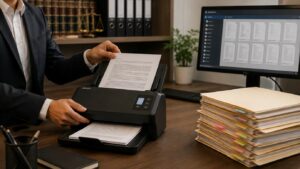
Each page is scanned and processed with optical character recognition, turning static documents into searchable text. A clause buried in a hundred-page contract becomes findable in seconds instead of requiring a manual page-by-page review.
Indexing for Case Management
Scanned files are indexed by case, client, and document type, then organized so they slot directly into your existing law firm document management system rather than sitting as a disorganized folder of scans.
3. Legal Records Digitization and Faster Case Preparation
Legal records digitization changes how quickly a firm can respond to deadlines. Attorneys preparing for trial can search an entire case file with a single keyword instead of digging through a banker’s box. Paralegals can assemble exhibit binders in a fraction of the time it used to take.
New associates joining a case can review its full history without waiting for someone to physically retrieve the paper files from storage. For firms juggling multiple active matters, that speed often determines whether a deadline is met comfortably or missed entirely.
4. Secure Legal Document Storage That Actually Protects Clients
Client confidentiality is not optional in legal work; it is the foundation the entire profession is built on. Secure legal document storage protects that foundation through encryption during transfer and storage, role-based access controls so only authorized staff can view a file, and detailed activity logs that record exactly who accessed a document and when.
This kind of protection also supports compliance with state bar confidentiality rules and, where relevant, other regulatory standards a firm’s practice area may touch. A trustworthy provider builds these protections into every step of the process rather than treating them as an afterthought.
5. Document Imaging for Law Firms and Disaster Recovery
Fires, floods, and simple building damage do not discriminate between important documents and unimportant ones; they destroy everything in their path. Document imaging for law firms solves this by creating a digital backup that exists independently of the physical office.
If a disaster strikes, a firm using digital archives can be back up and running with full access to its records almost immediately, while a paper-only office could lose years of case history permanently.
6. Legal File Scanning and the Move Toward a Paperless Law Office
Many firms are not making the jump to digital all at once; Access Scanning is ready to help make that transition smooth, This gradual approach lets a firm modernize its systems without disrupting active cases, converting historical files first and integrating new documents into the digital system going forward.
Over time, this shift toward a paperless law office frees up physical space once used for cabinets and storage boxes, reduces the ongoing cost of offsite archiving, and gives every attorney instant access to case history from a desktop or a phone.
7. Client Confidence and Professional Reputation
Clients notice how a firm handles their information, even if they never say so directly. A firm that can retrieve a document instantly, share files securely, and demonstrate a clear system for protecting sensitive information signals professionalism in a way paper storage simply cannot match. Using a legal document scanning service is not just an operational upgrade; it is a visible sign of care, responsibility, and respect for the client relationship.
This matters even more in competitive markets, where clients often compare how different firms handle their case before deciding who to hire. A firm that can pull up a document during a first consultation, rather than promising to find it later, projects a level of organization that builds confidence from the very first meeting. Over time, that kind of consistency becomes part of a firm’s reputation, not just its workflow.
8. What to Look for in a Legal Scanning Partner
Not every scanning provider treats legal documents with the same level of seriousness. Before choosing a partner, firms should ask a few direct questions.
- Does the provider track chain of custody from pickup through final delivery or storage?
- Is the scanning facility access controlled and staffed by background checked employees?
- Are files delivered with OCR and indexing that fits directly into your case management system?
- Will original documents be securely destroyed with certification, or returned upon request?
- Is pricing and turnaround time explained clearly upfront, with no hidden fees later?
A provider who answers these questions with a documented process rather than vague reassurance is one worth trusting with a firm’s most sensitive files.
Conclusion
For years, the locked filing cabinet felt like the standard for keeping legal records safe. It never really was. A lock does nothing against water, fire, or a single folder placed on the wrong shelf, and none of those risks pause just because a case is active or a deadline is close. Every case file a firm holds carries someone’s dispute, someone’s transaction, a piece of their life they trusted you to protect properly.
A legal document scanning service replaces that fragile trust with something far more dependable: records that cannot be soaked, misplaced, or destroyed in a single afternoon, and that can be found in seconds rather than searched for in hours. Firms that make this shift now will spend the coming years working faster and meeting deadlines with less stress, while the ones that wait will still be gambling on a cabinet.
If your firm is ready to move from overflowing file rooms to a secure, searchable digital archive, Access Scanning is ready to help make that transition smooth, secure, and built around exactly how your practice works.
Frequently Asked Questions
1. How long does a typical legal document scanning project take?
Turnaround depends on volume and document condition, but most projects are completed within a few days to a couple of weeks, with rush options available for firms facing tight deadlines.
2. Can scanned legal documents still be used in court?
Yes. Properly scanned and indexed documents that accurately reproduce the original are generally accepted as valid evidence, though firms should confirm specific requirements under local court rules.
3. What happens to the original paper files after scanning?
Depending on your firm’s retention policy, originals can be securely destroyed with a certificate of destruction, or returned to your office for internal archiving.
4. Is a legal document scanning service secure enough for privileged client communications?
Yes, provided the provider follows strict confidentiality protocols, including encrypted storage, restricted access, and a documented chain of custody for every file handled.
5. Can a small law office benefit from digitization, or is it only worthwhile for large firms?
Small offices often feel the benefit even more directly, since a single missing file can consume an entire staff member’s morning. Legal file scanning scales to the size of the practice, making it practical for firms of any size.