Patient care depends on speed. A lab result reviewed sooner, a treatment history pulled up in seconds, a referral reaching a specialist without delay- these small moments of efficiency add up to real outcomes. Yet many clinics and hospitals still rely on paper charts that slow every one of these steps down, forcing staff to search folders and physicians to piece together history from records that do not quite line up.
This is where medical records scanning services change the equation, converting paper into fast, searchable digital records that put information in front of providers exactly when patient care depends on it. This guide explores how that technology works and what to expect from a genuine HIPAA compliant scanning partner.
1. Why Paper Still Slows Down Patient Care
Most healthcare workflows were not designed around paper on purpose; they simply grew that way over decades. Intake forms, lab results, imaging reports, and physician notes pile up faster than any filing system can keep pace with. A single missing page can delay a diagnosis, and a misfiled chart can mean a provider is making decisions without the full picture.
Faster records lead to faster decisions, and faster decisions lead to better care. That simple chain is exactly why medical records scanning has moved from a back office convenience to a core part of running a modern practice.
2. How Healthcare Document Scanning Actually Works
Healthcare document scanning is more involved than feeding paper through a machine. A proper workflow includes several distinct steps that protect both the integrity of the record and the privacy of the patient.
Intake and Preparation
Charts are collected, sorted, and prepared for scanning, including removing staples and repairing damaged pages so nothing gets lost or skipped during the process.
Scanning and OCR
Each page is scanned and processed with optical character recognition, converting static images into searchable text. A provider looking for a specific lab value or medication no longer needs to flip through pages; a quick search brings up the exact result.
Indexing and Integration
Scanned files are indexed by patient name, date, and record type, then organized so they can be pulled up individually or integrated into an existing electronic medical records (EMR) system, keeping the digital chart consistent with how the practice already works.
Secure Storage and Access Controls
Once digitized, records are stored with encryption and role-based access, so only authorized staff can view sensitive information, and every access is logged for accountability.]
3. What HIPAA Compliant Scanning Actually Requires
Not every scanning provider handles patient information the same way, and healthcare organizations cannot afford to gamble on the difference. Genuine HIPAA compliant scanning includes a signed business associate agreement, encrypted transfer and storage of files, restricted access limited to trained and background-checked staff, and a documented chain of custody from pickup through final storage.
Providers should also be able to show proof of certified destruction for any paper originals that are shredded after scanning, rather than a verbal assurance that it happened.
4. How Digitization Improves Patient Safety
Paper is not just slow; it is also prone to errors that digital records avoid entirely. Handwriting can be misread, pages can be mixed up between patients, and a chart can simply go missing at the exact moment it is needed. Patient records digitization reduces each of these risks directly.
Files stay attached to the correct patient. Information stays legible and consistent. Fewer mix-ups mean fewer downstream mistakes, and patient safety improves in a way that is easy to overlook because it happens quietly in the background rather than through any single dramatic fix.
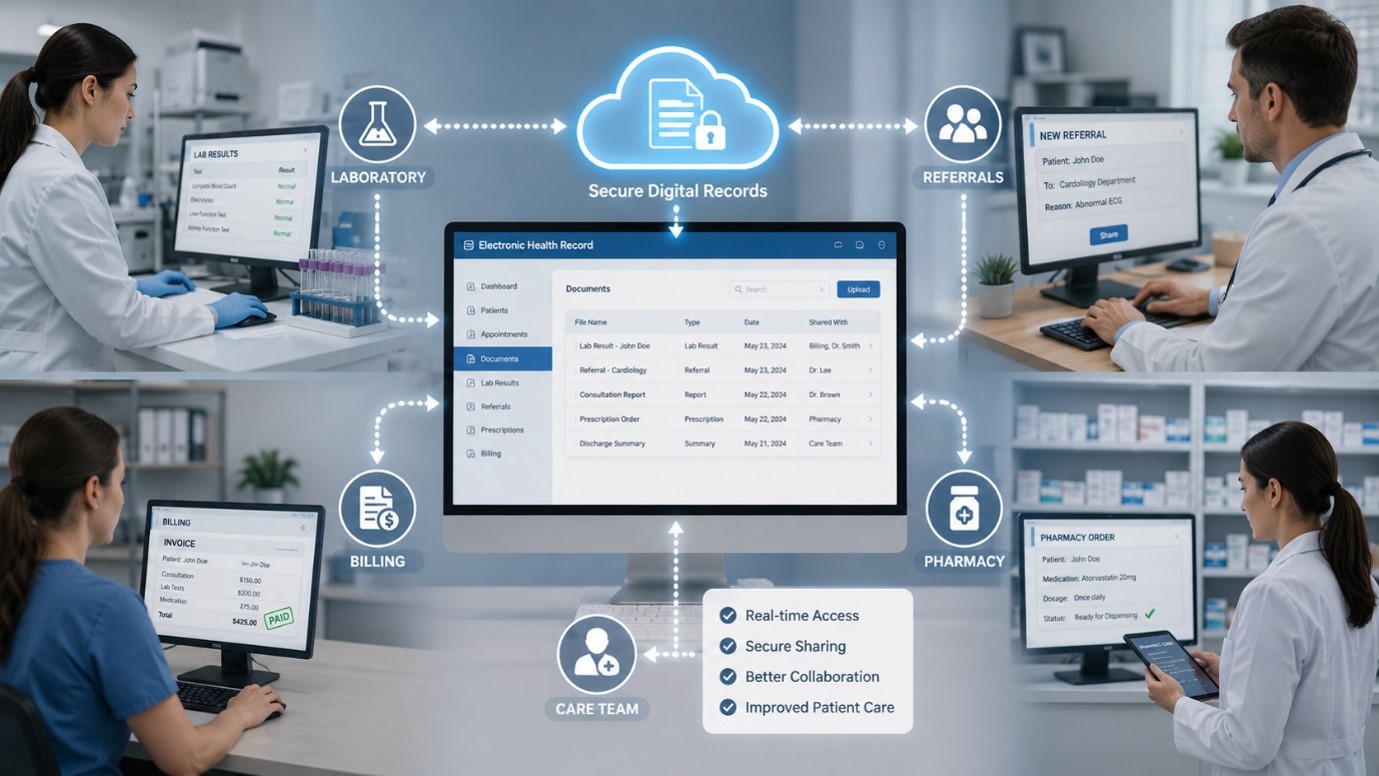
5. Better Coordination Across Departments and Providers
Hospitals and larger practices depend on smooth communication between departments, and paper is one of the biggest obstacles to that communication. Lab results have to physically travel to billing. Referrals move slowly between departments and outside specialists. Pharmacy orders wait on a chart that may currently be sitting on someone else’s desk.
Healthcare document management built around digital records removes these bottlenecks. A lab result becomes available the moment it is entered, a referral can be shared instantly and securely, and a specialist across town can review the same record a primary care physician is looking at, all without a single page changing hands.
6. Long Term Record Protection
Patient records are not only useful today; they often matter years or even decades later. Paper fades, tears, and gets lost over time, and a fire or flood can destroy years of medical history in minutes with no way to recover it. Digitized records solve this permanently. Files can be backed up automatically, stored redundantly across secure systems, and recovered quickly if anything goes wrong.
This matters beyond a single practice too. Patients change providers, move to new cities, or need old records pulled for insurance claims, legal cases, or ongoing treatment years after their last visit.
A digital archive makes that kind of retrieval simple, whereas a paper chart sitting in offsite storage might take days to locate, if it can be found at all. For a healthcare provider, that kind of long-term reliability is not a luxury; it is part of protecting continuity of care for every patient on file.
7. Medical File Scanning and the Shift Toward EMR Systems
Many practices are not choosing between paper and digital as a one-time decision; they are gradually shifting toward fully electronic systems. Medical file scanning is usually the first step in that shift, converting years of legacy paper charts into a digital archive that can then be integrated into an active EMR platform.
This approach lets practices modernize without losing access to historical patient data, and it means new patients and long-time patients alike benefit from the same searchable, centralized record system.
8. What to Look for in a Medical Records Scanning Partner
Choosing the right provider is just as important as the decision to digitize in the first place. Before signing on with a scanning partner, healthcare organizations should ask a few direct questions.
- Does the provider sign a business associate agreement and follow documented HIPAA-compliant scanning procedures?
- Is the scanning facility access controlled, monitored, and staffed by background-checked, trained employees?
- Are files delivered with OCR and structured indexing that integrates with existing EMR systems?
- Will original paper charts be securely destroyed with certification, or returned upon request?
- Is turnaround time and pricing clearly explained upfront, with no surprise fees added later?
A provider that answers these questions with a documented process, not vague reassurance, is one a healthcare organization can trust with patient information.
Conclusion: Records That Keep Up With Care
Every chart represents a patient who trusted a provider with their health history, and every minute spent searching for that chart is a minute taken away from actual care. Medical records scanning services turn that slow, error-prone process into something fast, accurate, and secure, giving providers the full picture the moment they need it instead of minutes or hours later.
The practices that make this shift now are the ones that will spend the next decade delivering faster, safer, more coordinated care, while the ones that wait will still be searching filing cabinets during appointments. If your organization is ready to move patient records into a system built for speed and security, Access Scanning is ready to help make that transition smooth and fully compliant.
Frequently Asked Questions
1. How long does a medical records scanning project usually take?
Turnaround depends on volume and the condition of existing charts, but most projects are completed within a few days to a couple of weeks, with rush options available for practices under time pressure.
2. Will digitized records work with our existing EMR system?
Yes, in most cases. Scanned records can be indexed and formatted to integrate directly into your existing electronic medical records platform, keeping historical charts alongside new digital entries.
3. What happens to the original paper charts after scanning?
Depending on your organization’s retention policy, originals can be securely destroyed with a certificate of destruction, or returned to your facility for internal archiving.
4. Is medical file scanning secure enough for sensitive psychiatric or substance use records?
Yes, provided the scanning provider follows strict HIPAA-compliant scanning procedures, including encrypted storage, restricted access, and a documented chain of custody for every file handled.
5. Can a small clinic benefit from digitization, or is it only worthwhile for large hospitals?
Small clinics often see an outsized benefit, since even a modest volume of paper can consume significant staff time when searched manually. Scanning scales to the size of the practice, making it practical for organizations of any size.