Introduction
Every day, a healthcare organization encounters numerous patient records. Managing paper documents is not just time-consuming but also results in staff having difficulties in retrieving data rapidly. Though doctors and nurses who are involved in giving patients excellent care can hardly spare time to efficiently manage records. Patient File Scanning Improves Healthcare significantly enhances the management of these records and ensures better patient care.
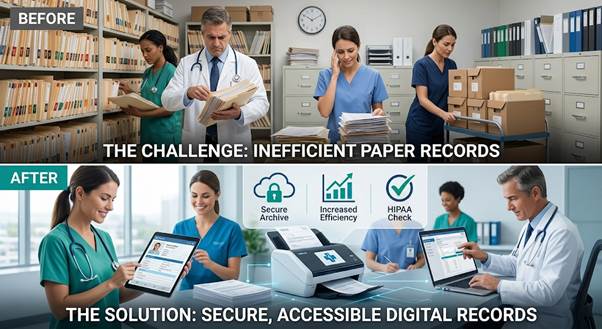
To simplify document handling, many clinics, hospitals, and doctors’ offices are shifting to electronic methods. Having a dependable Patient File Scanning Service is quite beneficial as it turns paper documents into safe digital files that can be easily arranged and accessed. Patient File Scanning Improves Healthcare by allowing healthcare experts to take advantage of this opportunity to increase their work productivity, minimize paperwork, and maintain reliable patient information.
Having patient records electronically, practitioners can focus more on working in caring for patients, speeding up work, and being much more involved in their teamwork and securing the health data. New tools of document management can also help with fulfilling all regulatory standards and provide the best care for the patient.
Furthermore, Patient File Scanning Improves Healthcare by enhancing the ability to share information among different departments, which is crucial in providing timely patient care.
In summary, Patient File Scanning Improves Healthcare by not only streamlining operations but also ensuring compliance and security of patient data.
Reduce Paper Records and Storage Challenges
Ultimately, Patient File Scanning Improves Healthcare by reducing the reliance on physical storage, thereby minimizing risks associated with paper records.
Paper files take up physical space, and they also need to be kept in a certain order. As the number of patients’ records goes up, it gets more difficult and expensive to handle filing cabinets and documents kept for a long time.
When healthcare providers understand how Patient File Scanning Improves Healthcare, they can better appreciate the transition to digital records.
With a Patient File Scanning Service, healthcare providers can digitize their paper records to create electronic documents that are much simpler to store and organize. In this way, the office can be de-cluttered and the expenses related to paper storage lowered.
Improve Access to Patient Information
Being able to quickly access patient information is vital in care and treatment centers. Looking for details in paper files might hold back treatment and the completion of other administrative tasks.
This transition shows how Patient File Scanning Improves Healthcare through enhanced data protection and regulatory compliance.
Moreover, Patient File Scanning Improves Healthcare as it helps healthcare facilities eliminate redundancy and inefficiency.
Thus, Patient File Scanning Improves Healthcare by streamlining the workflow and empowering staff to focus on patient care.
Making use of electronic records enables healthcare professionals to get important data in seconds. They simply have to log on to the system to view a patient’s history, allowing doctors and nurses to perform their jobs better, making accurate calls,s and even offering care at the right time.
Support HIPAA Compliance and Security
Additionally, Patient File Scanning Improves Healthcare by ensuring that critical data is easily accessible for all relevant personnel.
Protection of sensitive patient data is a top priority for healthcare organizations. Paper documents are vulnerable to risks such as being misplaced, stolen, or even damaged unintentionally.
Besides these benefits, digital records also provide the facility of being stored in an encrypted form, limited accessibility, and are backed up. Healthcare professionals through the Patient File Scanning Service still meet their compliance requirements and are not exposed to the danger of access by unauthorized persons.
Enhance Staff Productivity
It’s clear that Patient File Scanning Improves Healthcare while also preparing organizations for future challenges.
Administrative teams dedicate quite a few hours to managing paperwork and sorting physical files. Such monotonous tasks tend to bring down the overall productivity.
In conclusion, understanding how Patient File Scanning Improves Healthcare can lead to better decision-making in digital transformation.
Record digitalization assists with the organization of routine tasks. Staff can then focus on patient care and other important activities. Quicker document retrieval benefits the whole organization.
Enable Faster Collaboration Across Departments
Generally, different departments of healthcare facilities require patient information. Paper records that are physically shared between departments can interrupt communication and cause delays.
With digital files, collaboration is simple because the authorized personnel can get access to the records at the same time,e but securely. This leads to better teamwork between doctors, rs nurses, billing, and administration.
Ultimately, embracing Patient File Scanning Improves Healthcare is essential for organizations aiming for efficiency and excellence in patient care.
Protect Records with Digital Backup
For instance, natural disasters, fires,s or water damage are some unexpected events that may risk exposing the eye patient records. Besides, it could be almost an impossible task to restore the soiled paper files.
Using digital backup methods is a great way to complement the safety of medical records coordination. Safeguarded electronic copies come in handy when it is required to have access to the critical information still alive at the time of an incident, because of this, supporting the continuity of business and recovery from a disaster.
Scalable Solutions for Growing Healthcare Facilities
Finally, as we have discussed, Patient File Scanning Improves Healthcare by addressing multiple operational challenges faced by providers.
Healthcare organizations tend to accumulate substantial patient records as they grow. Handling higher volumes of paperwork may threaten continuity.
Expert scanning solutions extend different benefits that ramp up in scale as medical practices’ requirements. Working either with stored documents or live records, managed digital document systems ensure sustained efficiency and order.
Conclusion
Handling paper records could cause unnecessary delays and raise storage costs in healthcare organizations. Electronic document systems can facilitate operations, make information more accessible, and enhance the security of data.
When healthcare providers opt for a Patient File Scanning Service by Access Scanning Document Services, they are not only effectively setting up a well-ordered and efficient work environment but also supporting higher quality patient care through digitization of the paper records and getting themselves ready for the organization’s future development.
Read more: Discover how our Medical Chart Document Scanning Services help healthcare organizations convert paper records into secure, searchable digital files, reducing storage needs while improving document accessibility and patient care.
FAQs
Why do healthcare organizations digitize patient records?
Digitizing patient records makes them more accessible, more secure, and healthcare providers will be able to handle the patient’s information more efficiently.
Is patient file scanning secure?
Yes. Digital records can be secured by encrypting them, limiting access, and making backups regularly.
Can scanned records be searched easily?
Of course, OCR (optical character recognition) technology enables healthcare personnel to search the scanned documents quickly and bring back the relevant information.
Does file scanning help with HIPAA compliance?
Really. Digital records with secure storage and limited access can help meet compliance standards and secure patient information.
What types of healthcare records can be scanned?
Digitizing also includes things like patient charts, medical histories, insurance documents, billing records, consent forms, and archived files.