Stacks of unopened mail sitting on a desk are more common than most businesses admit. Bills, contracts, notices, customer forms. All of it arrives daily. Someone has to open everything, sort it, scan it, and file it somewhere. Hours disappear into this routine every week. That is one reason Mail Scanning Services Los Angeles is becoming more common across offices that want faster, cleaner document workflows. Physical mail slows things down. Digital access speeds things up. When businesses combine mail digitization with Document Scanning and Indexing, paperwork stops being a daily obstacle and starts becoming organized data.
This blog breaks down how mail scanning works and why it improves efficiency for modern businesses.
The Problem with Traditional Mail Handling
Paper still runs through many offices as it did twenty years ago. Mail arrives. Someone opens envelopes. Documents get sorted into piles. Important ones get scanned later. Some are copied. Some go into folders. Some disappear for a while before showing up again in a drawer somewhere.
Small inefficiencies stack up fast
Common issues businesses run into include:
- Lost or misplaced documents
- Delayed approvals and slower workflows
- Time wasted searching for physical files
- Limited access when staff work remotely
Even a small company might receive dozens of envelopes every day. Larger offices deal with hundreds. Over a month, that turns into thousands of pieces of paper. Paper creates friction. Digital files remove it.
How Mail Scanning Services Los Angeles Works
Mail scanning services act like a digital mailroom.
Instead of receiving physical mail at the office, businesses have it delivered to a secure processing center. Each envelope is opened, scanned, and converted into a digital file.
The basic workflow usually looks like this:
- Mail arrives at a secure scanning facility
- Documents are opened and scanned at high resolution
- Files are converted into searchable formats
- Indexed documents are uploaded to secure cloud storage
Employees can then access their mail instantly from a computer, phone, or internal system.
No waiting for someone in the office to check the mailbox.
Why Document Scanning and Indexing Matter
Scanning alone is helpful. Indexing is what truly saves time. Indexing adds searchable data to every document. This might include names, account numbers, invoice IDs, or dates. That information becomes part of the file’s metadata.
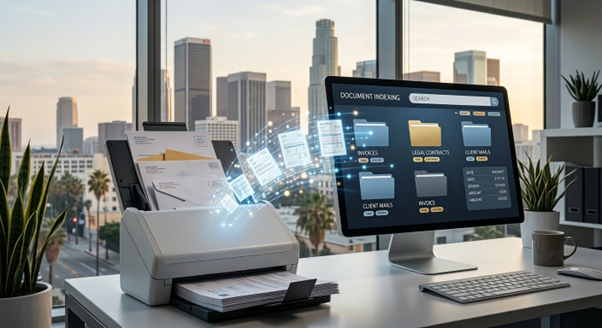
Document Scanning and Indexing
When properly indexed, documents become easy to locate.
Benefits of Document Scanning and Indexing include:
- Fast document searches instead of manual file digging
- Better organization across departments
- Improved collaboration between offices
- Simplified compliance and record tracking
Searching for a contract from two years ago might take seconds instead of half an hour. That difference adds up over time.
A Real Example From a Legal Office
Legal firms deal with a constant flow of documents. Client letters, court notices, billing statements, and signed agreements. Most of it arrives through traditional mail.
One mid-sized legal office switched to a mail scanning workflow where incoming documents were scanned and indexed by case number.
A few noticeable changes happened quickly
Document retrieval time dropped almost immediately. Staff no longer spent part of the day walking between filing cabinets. Remote attorneys could access documents without waiting for office assistants to scan them.
Productivity improved. Stress dropped a little too.
Industry research from records management groups shows employees spend nearly 20 percent of their workday searching for documents. Digital indexing cuts that time dramatically.
When Businesses Should Consider Mail Scanning
Certain signs usually appear when a company is ready for digital mail processing.
- Filing cabinets keep multiplying
- Staff regularly search for missing paperwork
- Teams work across multiple locations
- Sensitive records require stronger security controls
Paper storage grows quietly. Many offices only notice the problem once storage rooms start filling up. Mail scanning helps stop that cycle early.
The Long-Term Advantage of Digital Mail
Efficiency is the obvious benefit, but there are other gains too.
Digital mail systems support remote work. Documents stay protected through backups and encrypted storage. Disaster risks from fire or water damage drop significantly. Office space improves as well. Fewer filing cabinets. Less clutter. More room for actual work. Paper will never disappear completely. That is fine. The goal is simply to stop paper from controlling the workflow. Businesses that switch to digital mail management usually notice the difference pretty quickly.
Conclusion
Handling mail the traditional way slows modern businesses down. Mail Scanning Services Los Angeles solves that problem by turning incoming mail into organized digital files. When combined with Document Scanning and Indexing, companies gain faster document access, improved security, and smoother day-to-day operations.
Businesses that want a practical step toward a paperless workflow often rely on trusted providers such as Access Scanning Document Services to make that transition simple and efficient.